

Restaurant SEO and Local Search Optimization Services
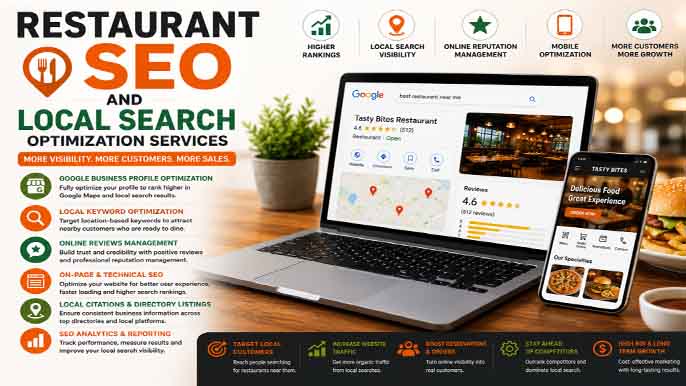
Restaurant SEO and Local Search Optimization Services
Running a successful restaurant today requires far more than great food and excellent service, since most potential customers now search online before deciding where to eat. Restaurant SEO and local search optimization services exist to help food businesses become visible to hungry customers searching nearby, ensuring that a restaurant appears prominently when someone types a relevant query Online Food Ordering Website Development Services into a search engine. These services combine technical website optimization with location based marketing strategies specifically designed for the food and hospitality industry. This article explores how restaurant SEO works, why local visibility matters so much in this industry, and how specialized optimization strategies help restaurants attract more diners, while naturally incorporating important concepts such as local search visibility, online reputation management, and search engine ranking factors, all of which play a critical role in helping restaurants thrive in a competitive digital landscape.
Why Local Search Matters More for Restaurants Than Other Businesses ?
Unlike many other types of businesses, restaurants rely almost entirely on customers who are physically nearby and ready to make a decision quickly. Someone searching for a place to eat is often hungry, pressed for time, and willing to choose from whichever options appear most prominently and appear most trustworthy in their search results. This makes local search visibility particularly important for restaurants compared to businesses that serve customers across wider geographic areas or through online sales. When a restaurant fails to appear in local search results or map listings, it essentially becomes invisible to a huge portion of potential customers who never venture beyond the first few options presented to them. This urgency and immediacy in restaurant searches makes local optimization not just helpful but absolutely essential for survival in competitive dining markets.
The Role of Google Business Profile in Restaurant Visibility
A properly optimized Google Business Profile often serves as the single most important factor in determining whether a restaurant appears in local search results and map listings. This free listing displays critical information such as operating hours, menu links, photos, customer reviews, and direct contact details directly within search results, often before a potential customer even visits the restaurant's actual website. Restaurant SEO services typically begin by ensuring this profile is fully completed, accurately categorized, and regularly updated with fresh photos and posts. Many restaurant owners create this profile once and then ignore it for years, missing out on the significant ranking boost that comes from active, well maintained business listings that search engines view as trustworthy and currently operational.
Optimizing Restaurant Websites for Local Search
While business listings matter enormously, a restaurant's own website still plays a crucial role in supporting overall local search performance. Website optimization for restaurants involves ensuring that location specific information, such as the city or neighborhood name, appears naturally throughout page titles, headings, and content. This helps search engines clearly understand exactly where the restaurant operates and which local searches it should appear for. Beyond location signals, restaurant websites need fast loading speeds, mobile friendly design, and clear navigation, since many potential diners search for restaurants while already out and about using their smartphones. A slow or confusing website can cause potential customers to abandon their search and choose a competitor instead, regardless of how good the actual food might be.
The Importance of Consistent Business Information Across Platforms
Search engines place significant weight on consistency when determining which businesses deserve top placement in local search results. This means a restaurant's name, address, and phone number must match exactly across every platform where the business appears, including its website, social media profiles, and various online directories. Even small inconsistencies, such as using a different phone number on one platform or an outdated address on another, can confuse search engines and reduce trust signals. Restaurant SEO services often conduct thorough audits across dozens of directories and platforms to identify and correct these inconsistencies, since cleaning up scattered or outdated information frequently produces noticeable improvements in local search rankings within a relatively short period of time.
Customer Reviews and Online Reputation Management
Few factors influence both search rankings and customer decision making as strongly as online reviews. Potential diners frequently read reviews before choosing a restaurant, and search engines themselves use review quantity, quality, and recency as significant ranking signals. Online reputation management therefore becomes a central focus of restaurant SEO strategies, involving proactive efforts to encourage satisfied customers to leave reviews while also responding thoughtfully to both positive and negative feedback. A restaurant that actively engages with its reviews demonstrates to both search engines and potential customers that it cares about service quality and customer satisfaction. Ignoring negative reviews or failing to respond at all often signals neglect, while thoughtful responses to criticism can actually build trust with future customers who see how problems were handled professionally.
Local Citations and Directory Listings
Beyond major platforms like Google, restaurants benefit significantly from being listed accurately across various local directories, review platforms, and industry specific websites related to food and dining. These listings, often called citations, help establish credibility and relevance in the eyes of search engines, particularly when they consistently confirm the same business information across multiple trusted sources. Restaurant SEO services typically identify the most valuable directories for the food industry, ensuring the business is listed accurately on platforms that potential customers actually use when searching for dining options. Building these citations strategically, rather than randomly submitting information everywhere, helps create a strong foundation of trust signals that support overall local search performance over time.
Menu Optimization and Structured Data
Many restaurant owners overlook how their online menu can be optimized to improve search visibility, often treating it as simply a static image or PDF document attached to their website. However, search engines struggle to read text embedded within images, meaning valuable menu information often becomes completely invisible to search algorithms. Effective restaurant SEO involves presenting menu items as actual readable text on the website, often supported by structured data markup that explicitly tells search engines what each item represents, including its name, description, and price. This structured approach not only improves visibility for specific dish searches but also enables rich search result features, such as displaying menu highlights directly within search listings, which can significantly increase click through rates from potential customers browsing search results.
Content Marketing Strategies for Restaurants
Beyond technical optimization, content marketing plays a valuable role in strengthening a restaurant's overall search presence and customer engagement. Blog posts about seasonal menu items, behind the scenes stories about ingredient sourcing, or articles highlighting local Restaurant Branding and Digital Marketing Solutions events near the restaurant all provide opportunities to naturally incorporate relevant keywords while genuinely engaging potential customers. This type of content also gives search engines more reasons to view the website as an active, valuable resource rather than a static page that rarely updates. Restaurants that consistently produce thoughtful content related to their cuisine, neighborhood, or dining experience often see improved search performance compared to competitors who treat their website as a simple digital business card with no ongoing content strategy.
Mobile Optimization and the Search Behavior of Diners
Given how frequently people search for restaurants while already out and hungry, mobile optimization deserves special attention within any restaurant SEO strategy. Search behavior on mobile devices often differs from desktop searching, with users typically looking for immediate answers such as current operating hours, distance from their location, or quick access to a phone number for reservations. Restaurant websites must therefore prioritize fast loading times, easily tappable buttons, and clearly visible contact information near the top of mobile pages. Search engines themselves heavily favor mobile friendly websites when determining local search rankings, meaning restaurants with outdated or poorly optimized mobile experiences often struggle to compete effectively, regardless of how strong their actual food offering or customer service might genuinely be.
Seasonal and Event Based Local SEO Strategies
Restaurants often experience significant fluctuations in demand based on seasons, holidays, and local events, creating valuable opportunities for targeted local SEO efforts. Updating business listings and website content to highlight holiday specials, seasonal menu changes, or participation in local food festivals can capture additional search traffic during these high demand periods. Search engine ranking factors often respond positively to fresh, timely content that demonstrates active business engagement with current events and seasonal trends. Restaurant SEO services frequently build content calendars around these predictable demand fluctuations, ensuring that relevant pages and listings are updated proactively rather than reactively scrambling to capture seasonal search traffic after the optimal window has already passed.
Competitor Analysis Within Local Dining Markets
Understanding how nearby competing restaurants approach their own online presence provides valuable insight for shaping an effective local SEO strategy. Analyzing competitor websites, review profiles, and search rankings helps identify gaps and opportunities that a restaurant can exploit to gain competitive advantage. This might reveal that competitors are neglecting certain keyword opportunities, failing to respond to reviews, or missing valuable directory listings altogether. Restaurant SEO services often incorporate this competitive research into their broader strategy, ensuring that recommendations are grounded in the actual local dining landscape rather than generic best practices that fail to account for the specific competitive dynamics within a particular neighborhood or city.
Measuring Success Through Local Search Metrics
Effective restaurant SEO requires ongoing measurement to understand whether optimization efforts are actually producing meaningful business results rather than simply theoretical improvements. Key metrics often include changes in local search ranking positions, increases in website traffic from local searches, growth in phone calls or direction requests generated through business listings, and overall changes in review volume and average rating. Tracking these metrics over time helps restaurant owners understand which specific strategies are producing genuine results, allowing for continuous refinement of the overall approach. Without this measurement, restaurants risk continuing to invest time and resources into strategies that may have worked initially but have since become less effective as search algorithms and competitive landscapes continue evolving.
Long Term Value of Investing in Restaurant SEO
While some restaurant owners view marketing spending primarily through the lens of immediate, short term promotions, investing consistently in local search optimization tends to produce compounding benefits over time. Restaurants that maintain accurate listings, actively manage their Multi Restaurant Food Delivery Platform Development online reputation, and continuously update their website content typically build stronger search authority that becomes increasingly difficult for newer competitors to quickly replicate. This long term visibility translates directly into a steady stream of new customers discovering the restaurant through organic search, often at a significantly lower cost compared to ongoing paid advertising campaigns. Restaurants that treat SEO as an ongoing commitment rather than a one time project consistently outperform competitors who only address their online presence sporadically whenever business slows down noticeably.
Conclusion
Restaurant SEO and local search optimization services provide essential support for food businesses navigating an increasingly digital customer journey from search to seated table. From optimizing Google Business Profiles and managing online reviews to ensuring mobile friendly websites and accurate directory listings, every element of local optimization contributes to a restaurant's ability to attract hungry customers actively searching nearby. Local search visibility, online reputation management, and search engine ranking factors work together as interconnected pillars supporting sustainable restaurant growth rather than existing as separate, unrelated marketing tasks. Restaurants that commit to consistent, thoughtful optimization position themselves to capture a larger share of local diners, building lasting visibility that continues delivering value well beyond any single marketing campaign or seasonal promotion.
Add a Comment
Categories
- Authentic Mughlai Restaurants 1
- Best Biryani in Pakistan 13
- Cafes for Coffee 6
- Desi Breakfast 2
- Dining Experiences & Lifestyle 6
- Family-Friendly Restaurants 5
- Food Culture & Community 6
- Food Trends & Tips 5
- Hidden Gem Restaurants 2
- Pakistan Restaurants 8
- Pakistani Cuisine 5
- Rooftop Restaurants 2
- Street Food In Karachi 1
- Top Restaurants in Lahore 7
- Vegan and Vegetarian 1
