

Multi-Restaurant Food Ordering and Delivery Management Platform
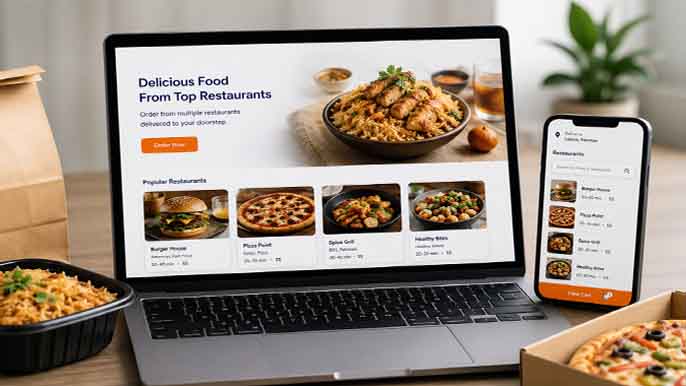
Multi-Restaurant Food Ordering and Delivery Management Platform
Introduction to Multi-Restaurant Food Ordering and Delivery Management Platform
The food delivery industry has experienced remarkable growth over the past decade, completely changing how customers discover restaurants and order meals online. Modern consumers expect convenience, fast delivery, secure payments, and real-time order tracking through a single digital platform. An Online Food Ordering and Restaurant Listing Platform in Pakistan provides customers with access to multiple restaurants, allowing them to browse menus, compare prices, place orders, and track deliveries without installing separate applications for every restaurant.
A multi-restaurant food ordering platform is one of the most advanced digital business solutions available today. It connects customers, restaurant owners, delivery riders, and administrators through one centralized ecosystem. With Professional Restaurant Marketing and Online Ordering Solutions, restaurant owners can increase online visibility, receive more orders, manage menus efficiently, and grow their business while customers enjoy a seamless ordering experience.
Unlike single restaurant applications, multi-vendor food ordering systems combine hundreds of restaurants into one platform. Customers can search by cuisine, location, ratings, delivery time, and pricing while restaurant partners receive powerful management tools to monitor orders, update menus, and analyze business performance. This integrated approach benefits every stakeholder involved in the food delivery ecosystem.
Understanding the Core Stakeholders
A successful food ordering and delivery platform must satisfy the needs of three major stakeholders. Each user interacts with the platform differently and requires dedicated features that improve efficiency and overall experience.
Customers
Customers represent the largest user group on the platform. They expect an intuitive interface that enables them to quickly discover restaurants, browse menus, customize meals, place secure orders, and monitor deliveries in real time. Fast loading pages, accurate restaurant information, multiple payment methods, and transparent pricing contribute significantly to customer satisfaction.
Modern customers also appreciate personalized recommendations, promotional discounts, loyalty rewards, and saved favorite restaurants. These features encourage repeat purchases while improving overall engagement with the platform.
Restaurant Partners
Restaurant owners require comprehensive management tools that simplify online business operations. The restaurant dashboard allows owners to manage menus, update pricing, monitor incoming orders, adjust food availability, view customer feedback, and generate sales reports. These features help restaurants operate efficiently while increasing online revenue.
Many restaurant businesses rely on the Best Food Delivery and Restaurant Discovery Services in Pakistan to attract new customers, improve digital visibility, and expand delivery coverage without investing heavily in independent software development.
Delivery Personnel
Delivery riders require a dedicated mobile application that allows them to receive delivery requests, navigate efficiently using GPS, communicate with customers, and update delivery status instantly. Efficient rider management directly influences delivery speed, customer satisfaction, and overall platform reliability.
The rider application should display pickup locations, optimized delivery routes, estimated travel time, earnings information, completed deliveries, and customer contact details while ensuring real-time synchronization with restaurants and customers.
Key Features of the Platform
A comprehensive multi-restaurant ordering system combines numerous advanced features that improve customer convenience, simplify restaurant operations, and optimize delivery management. Each feature contributes to creating a reliable and scalable digital food ordering ecosystem.
Restaurant Discovery and Menu Browsing
The customer application should include intelligent search and filtering options that help users discover restaurants based on cuisine, location, ratings, delivery charges, estimated delivery time, price range, promotional offers, and customer reviews. High-quality food images, detailed menu descriptions, nutritional information, and customization options enable customers to make informed purchasing decisions quickly.
Category-based browsing, keyword search, trending restaurants, featured dishes, and personalized recommendations further enhance user experience while increasing restaurant visibility and customer engagement.
Real-Time Order Placement and Tracking
Once customers have selected their preferred meals, the platform should provide a smooth and secure checkout process. Customers can review their cart, customize food items, add special cooking instructions, apply discount coupons, choose delivery addresses, and select their preferred payment method before confirming the order.
Real-time order tracking is one of the platform's most valuable features. Customers receive live updates as their order progresses through various stages, including order confirmation, restaurant preparation, rider assignment, pickup, delivery, and successful completion. Continuous tracking improves transparency while significantly increasing customer confidence throughout the ordering process.
Restaurant Management Dashboard
Restaurant partners require a powerful administrative dashboard that simplifies daily operations. Through this dashboard, restaurant owners can manage food categories, upload menu images, edit pricing, update availability, accept or reject incoming orders, monitor delivery progress, and communicate directly with customers when necessary.
The dashboard also provides valuable business insights through sales reports, customer order history, revenue analysis, popular menu items, and peak ordering hours. These reports help restaurant owners make informed business decisions and improve operational efficiency.
Delivery Assignment and Route Optimization
Efficient delivery management plays a major role in customer satisfaction. Once an order is prepared, the system automatically assigns it to the nearest available delivery rider based on current location, workload, delivery distance, and estimated arrival time.
GPS integration and intelligent route optimization algorithms calculate the fastest delivery routes while avoiding traffic congestion whenever possible. Efficient routing minimizes delivery time, reduces fuel costs, and improves overall service quality.
Payment Processing and Financial Management
A reliable payment gateway is essential for any online food ordering platform. The system should support multiple payment options including debit cards, credit cards, online banking, digital wallets, mobile payment applications, and cash on delivery.
The financial management system automatically calculates restaurant earnings, delivery charges, taxes, platform commissions, promotional discounts, and rider compensation. Accurate financial reporting ensures transparency between customers, restaurants, delivery personnel, and platform administrators.
Ratings, Reviews, and Customer Feedback
Customer feedback helps maintain service quality across the platform. After every completed order, customers should have the opportunity to rate restaurants, food quality, delivery service, and overall experience while submitting written reviews.
Positive reviews increase restaurant credibility and attract more customers, while constructive feedback helps restaurant owners identify operational improvements. Review moderation tools also help maintain authentic customer experiences across the platform.
Push Notifications and Customer Communication
Push notifications keep all stakeholders informed throughout the order lifecycle. Customers receive instant alerts regarding order confirmation, food preparation, rider assignment, estimated delivery time, and successful delivery completion.
Restaurant owners receive notifications for new orders, cancellations, payment confirmations, and customer messages. Delivery riders are notified whenever new delivery requests become available or delivery instructions are updated.
System Architecture and Technical Design
Developing a multi-restaurant food ordering platform requires a carefully planned architecture capable of supporting thousands of simultaneous users while maintaining high availability, fast response times, and reliable data synchronization.
Microservices Architecture
Modern food delivery applications commonly adopt a microservices architecture where different platform components operate independently. Individual services manage customer accounts, restaurant operations, order processing, payment transactions, notifications, delivery management, reporting, and analytics.
This architecture improves scalability, simplifies software maintenance, enables independent feature updates, and minimizes downtime during future enhancements.
Database Design Considerations
The platform stores a large volume of information including customer profiles, restaurant information, menu items, payment records, delivery logs, rider details, reviews, and transaction history. Proper database design ensures efficient data retrieval while maintaining accuracy and security.
Relational databases such as MySQL or PostgreSQL efficiently manage structured transactional data, while NoSQL databases like MongoDB or Redis support caching, session management, and high-speed real-time updates required for live tracking and notifications.
Real-Time Communication Infrastructure
Real-time communication allows customers, restaurants, delivery riders, and administrators to receive instant updates throughout the ordering process. Technologies such as WebSockets, Firebase Cloud Messaging, and push notification services enable continuous synchronization across every connected device.
This infrastructure ensures that order status changes appear immediately without requiring users to manually refresh the application, creating a smoother and more interactive user experience.
Geolocation and Mapping Integration
Location-based services are fundamental to the success of a multi-restaurant food ordering platform. GPS technology enables customers to discover nearby restaurants, accurately verify delivery addresses, monitor rider locations, and receive estimated delivery times. Integration with mapping APIs such as Google Maps allows the system to calculate optimal routes while improving delivery accuracy and reducing travel time.
Geolocation services also assist restaurant partners in defining delivery zones, calculating delivery charges based on distance, and expanding service coverage efficiently. Accurate location tracking contributes significantly to operational efficiency and customer satisfaction.
Scalability and Load Management
Food ordering platforms experience significant traffic spikes during breakfast, lunch, dinner, weekends, and public holidays. Therefore, the platform should be designed using cloud infrastructure capable of automatically scaling resources based on user demand.
Load balancing, caching mechanisms, content delivery networks (CDNs), and distributed databases help maintain fast response times even during periods of heavy traffic. Auto-scaling infrastructure ensures uninterrupted service while minimizing operational costs during low-demand periods.
Development Approach and Technology Stack
Developing a scalable food ordering platform requires selecting technologies that provide performance, flexibility, security, and future scalability. Every software layer should be carefully planned before development begins.
Frontend Development
The customer application should be available as both a responsive website and a mobile application. Technologies such as HTML5, CSS3, Bootstrap, JavaScript, React.js, Vue.js, and Angular are commonly used for web development.
For mobile applications, developers frequently use Flutter or React Native to build Android and iOS applications from a single codebase. This approach reduces development time while maintaining a consistent user experience across multiple devices.
Backend Development
The backend manages business logic, order processing, authentication, payment transactions, restaurant management, delivery coordination, and communication between all platform components. Popular backend technologies include Node.js, Laravel, Django, ASP.NET Core, Java Spring Boot, and Express.js.
RESTful APIs and GraphQL services facilitate secure communication between mobile applications, web applications, restaurant dashboards, delivery applications, and administrative portals.
Database Selection
Relational databases including MySQL and PostgreSQL efficiently manage customer accounts, restaurant information, orders, invoices, and payment records. Non-relational databases such as MongoDB and Redis improve application performance by supporting caching, live sessions, notifications, and real-time tracking information.
Regular database optimization, indexing, backup strategies, and disaster recovery planning ensure long-term reliability while protecting valuable business information.
Security Considerations
Security is one of the highest priorities when developing an online food ordering platform. Customer information, payment details, restaurant records, and location data must be protected using strong authentication, encrypted communication, secure APIs, and role-based authorization.
Payment processing should comply with international security standards while preventing fraud, unauthorized access, and financial data breaches. Regular penetration testing, vulnerability assessments, software updates, and security monitoring help maintain platform integrity.
Challenges in Development and Deployment
Developing a multi-restaurant ordering platform presents several technical and operational challenges. Synchronizing customer orders, restaurant preparation, rider assignments, payment processing, and delivery tracking in real time requires highly optimized software architecture and continuous monitoring.
Traffic congestion, restaurant delays, order modifications, payment failures, and network interruptions can affect delivery performance. Intelligent automation, fault-tolerant infrastructure, and effective exception handling help minimize these operational challenges.
Managing multiple restaurants with different operating hours, delivery zones, pricing structures, promotional campaigns, and menu updates also requires flexible administrative tools capable of handling dynamic business requirements.
Testing and Quality Assurance
Comprehensive software testing ensures the platform performs reliably under real-world conditions. Functional testing verifies every feature, while integration testing confirms smooth communication between customers, restaurants, delivery riders, payment gateways, and administrators.
Load testing evaluates system performance during periods of heavy user activity, ensuring the platform remains responsive under thousands of simultaneous requests. Security testing identifies vulnerabilities before deployment, while user acceptance testing collects practical feedback from restaurant owners, delivery personnel, and customers.
Continuous quality assurance throughout development minimizes software defects, improves platform stability, and delivers a superior user experience.
Conclusion
The Multi-Restaurant Food Ordering and Delivery Management Platform represents a complete digital ecosystem that connects customers, restaurants, delivery personnel, and administrators through one intelligent platform. Features including restaurant discovery, real-time order tracking, secure payment processing, delivery optimization, and advanced analytics create a seamless food ordering experience for every stakeholder.
By implementing an Online Food Ordering and Restaurant Listing Platform in Pakistan, businesses can efficiently connect thousands of restaurants with customers while expanding their digital presence. Combined with Professional Restaurant Marketing and Online Ordering Solutions, restaurants gain powerful business tools that increase online visibility, customer engagement, and overall sales performance.
Furthermore, the Best Food Delivery and Restaurant Discovery Services in Pakistan continue to transform the country's food delivery industry by providing fast, reliable, secure, and scalable solutions for restaurants and consumers alike. With modern technologies, cloud infrastructure, robust security, and customer-focused design, multi-restaurant food delivery platforms will remain essential components of the rapidly growing digital economy.
Add a Comment
Categories
- Authentic Mughlai Restaurants 1
- Best Biryani in Pakistan 13
- Cafes for Coffee 6
- Desi Breakfast 2
- Dining Experiences & Lifestyle 6
- Family-Friendly Restaurants 5
- Food Culture & Community 6
- Food Trends & Tips 5
- Hidden Gem Restaurants 2
- Pakistan Restaurants 8
- Pakistani Cuisine 5
- Rooftop Restaurants 2
- Street Food In Karachi 1
- Top Restaurants in Lahore 7
- Vegan and Vegetarian 1
